What Actually Happens in a Sacred Intimacy Session? A First-Timer's Guide
Let me guess.
You've been on this website for a while. You've read the about page. You've looked at the services. You've maybe Googled "sacred intimacy" three or four times across different browser sessions, half of which were in incognito mode because, honestly, fair enough.
And the question you keep circling back to is the one that feels too obvious to ask: but what actually happens?
It's a good question. It's the right question. And the reason it's hard to answer is that most practitioners, myself included until right now, tend to describe sacred intimacy in language that's evocative but not especially specific. Transformative container. Embodied presence. Intentional touch. These phrases aren't wrong. They're just not particularly useful if you've never been in the room.
So here's the room.
Before you ever set foot in it: the clarity call
Everything starts with a free 15-minute phone call.
This is not a sales call. I am not going to tell you how life-changing the work is and then ask for your credit card. It's a conversation: you tell me what's drawing you to this work, what questions you have, what concerns you, and I tell you honestly whether I think what I do is a good fit for what you're looking for.
Some people come to this call with a clear sense of what they want. Most come with a vague pull toward something and a lot of uncertainty about what to call it. Both are fine. The call exists precisely so you can figure out whether to take the next step without committing to anything first.
If you decide to book after the call, great. If you decide it's not quite right, also great. I'd rather you find the right fit than book a session you're not sure about and spend the whole thing wondering if you made a mistake.
Arriving: what the space is like
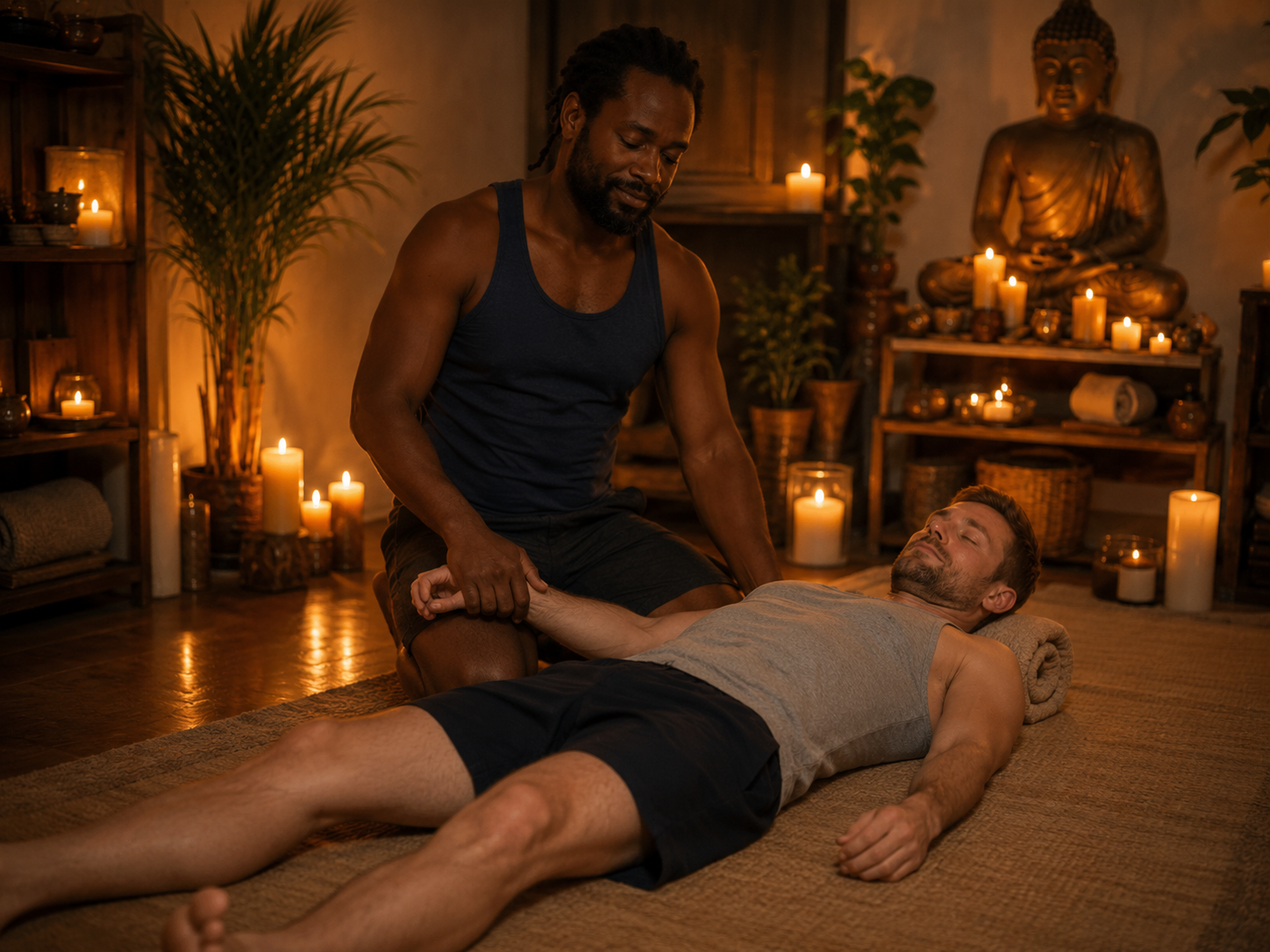
My studio is in Hollywood, a private space on Waring Ave near Hudson. It doesn't look like a clinic. It doesn't look like a spa either, for that matter. It's warm, quiet, and deliberately ordinary in the best sense: it's a room where you can actually relax rather than feeling like you're supposed to be having a particular experience the moment you walk in.
There's no receptionist, no waiting room, no one else in the hallway. You come in, you sit down, you get offered tea or water, and for a few minutes we just let you arrive. This sounds simple. For a lot of men who've been keyed up about the session all week, it's actually the most useful part of the first fifteen minutes.
The intake conversation
Before anything happens with touch, we talk.
This isn't a medical intake form read aloud. It's a real conversation about what you're bringing to the session that day: what drew you here, what you're hoping to explore, what you'd like more of, and what you'd like to stay well away from. I'll ask about your history with touch and bodywork, and whether there's anything I should know about your body or your experience that would help me work with you well.
We'll also establish consent: explicitly, out loud, without awkwardness. I'll explain what I'm proposing and you'll tell me what's a yes, what's a no, and what's a maybe-let's-see. You can change any of these at any point during the session. The consent conversation isn't a formality we get through so the real stuff can start. It is the real stuff, in a sense. It sets the tone for everything that follows.
This whole conversation usually takes twenty to thirty minutes. Some men are relieved by how normal it feels. Some are surprised that we're still talking. Both responses are completely reasonable.
The bodywork: what it actually involves
Sacred intimacy sessions involve mindful touch. The client is typically undraped for portions of the session, though the pace of that and what it involves is always guided by what we've agreed on in the intake conversation. Touch is slow, intentional, and attentive: it's not performance and it's not a massage checklist. It follows your nervous system more than it follows a protocol.
We use breathwork throughout, because breath is the most direct tool available for working with the nervous system. I'll cue you to breathe in particular ways at particular moments, and you'll probably notice that something shifts when you do. Breath isn't magic. It's just physiology. But it works.
Depending on what you came for and what we've discussed, sessions can include work with erotic energy: touch that moves toward and through areas of the body that carry erotic charge. This is intimate work. It is not a transaction or a service in the way that phrase usually implies. The distinction is real and it matters to how the session is held.
Some sessions are relatively quiet. Some involve a lot of emotion. Some men are surprised to find themselves crying about twenty minutes in without quite knowing why. I want to say clearly: that's not a malfunction. That's the work working. The body holds things, and when it gets sustained, unhurried attention in a safe container, some of what it's been holding moves.
I am present the entire time, not just physically but actually present: tracking your breath, your body language, your nervous system. Checking in verbally when it's useful. Adjusting as we go.
The closing
Sessions don't end with a handshake and a "see you next time."
The last portion of every session is a grounding sequence: a few minutes of stillness, some breath, a deliberate transition from the heightened state of the session back toward ordinary consciousness. This matters more than people expect. Moving too quickly from a deep somatic experience back into the world tends to leave men feeling unmoored. We take our time here.
After the grounding, we usually sit and talk for a few minutes. Sometimes a lot comes up that wants to be named. Sometimes there's nothing to say and that's fine too. You're welcome to take whatever time you need before you walk out.
Some men feel lighter afterward. Some feel tired. Some feel oddly emotional for a day or two, processing something that got loose in the session. All of this is within the range of normal. I'm reachable by message for any follow-up reflection that comes up later.
What sessions are for, and what they're not
Sacred intimacy sessions are not sexual services. They are intimate, sometimes erotic, and body-centered. They are not transactional encounters. There is no service being purchased in the euphemistic sense. This is a real distinction and it matters: legally, ethically, and in terms of what actually happens in the room.
Sessions are also not therapy. I'm not a licensed psychotherapist. I don't diagnose, treat, or give you homework in the clinical sense. What I do is create a somatic container where experience can move through the body rather than simply being described. If you're in therapy, this work tends to complement it well. If you're not, some of what comes up in sessions can be useful to bring to a therapist if you decide to work with one.
Who tends to come, and why
I've worked with men in their twenties and men in their seventies. Gay men, bisexual men, straight men, and men who haven't settled on a label. Men who have never been to any kind of bodywork. Men who have done years of therapy and feel like something is still missing. Men who are navigating disconnection in a long-term relationship. Men who haven't been touched by another human being in longer than they want to think about.
The common thread is usually this: a sense that something in their relationship to their body, their desire, or their capacity for intimacy is not quite right. Not broken, not diagnosable, just... not fully available. Like a room in the house that's been closed off for a while. The work is, in some sense, about opening that room back up.
If that sounds like something you've been carrying, the clarity call is a genuinely low-stakes place to start. It's fifteen minutes. It's free. And it will tell you far more about whether this is right for you than any page on this website can.
Frequently asked questions
How long are sessions, and which length should I choose for my first time?
Sessions run 90 minutes, two hours, or three hours. For a first session, most men book 90 minutes. It's enough time to have a real intake conversation, do substantive bodywork, and close properly without feeling rushed. Some men prefer to start with two hours if they know they tend to take time to settle. I'd rather you book 90 minutes and leave wanting more than book three hours and spend the first hour wondering what you've gotten yourself into.
Do I need to do anything to prepare?
A few practical things: shower before you come, avoid heavy meals in the two hours before a session, and arrive sober. Beyond that, there's nothing to do. You don't need to meditate, stretch, or arrive in any particular mental state. Nervous is fine. Uncertain is fine. Skeptical is actually fine too: skepticism hasn't stopped anyone from having a useful session.
What if I don't know what I want from the session?
That's the most common starting point, honestly. "I'm not sure, I just know something is off" is a complete reason to book. Part of what the intake conversation does is help you get clearer on what you're actually there for. You don't have to know before you arrive.
Will you remember what we discussed if I book again?
Yes. I keep notes between sessions, with your knowledge, so that returning clients don't have to re-establish context every time. The work builds. Each session informs the next.
What's your cancellation policy?
I ask for 24 hours notice for cancellations or rescheduling. Life happens and I'm a reasonable person about it, but the time is held specifically for you, and late cancellations are difficult to fill. If something comes up, just let me know as soon as you can.
I have a disability or a chronic health condition. Can I still do this work?
In most cases, yes. I adapt to bodies, not the other way around. If you have something specific you want to make sure I know about before we start, the clarity call is the right place to share it. I'd rather know in advance so I can work with you thoughtfully.
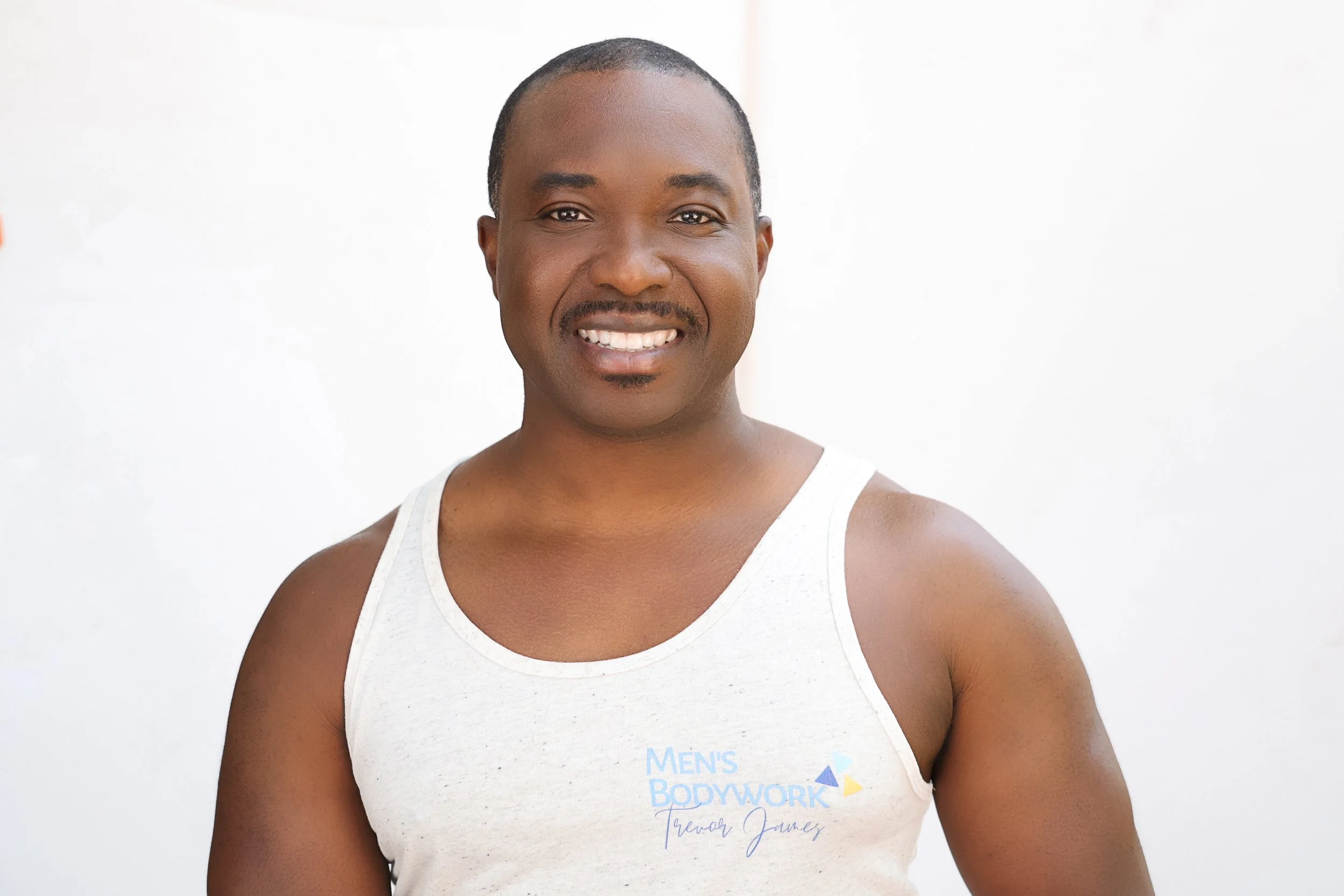
Trevor James is a sacred intimacy practitioner, somatic coach, and author based in Los Angeles. He has worked with men across orientations and backgrounds for eight years. His studio is in Hollywood. He can be reached at trevor@trevorjamesla.com or at (213) 588-4242.