Sacred Intimacy for Gay and Bisexual Men: Why Queer Erotic Experience Deserves Its Own Container

Let me say something that doesn't get said enough in wellness spaces.
"Inclusive" is not the same as "designed for you."
A lot of spaces that serve gay and bisexual men are, at best, straight-wellness-with-a-rainbow-flag. The language is adjusted, the stock photos are updated, and the underlying framework remains built around a default experience that isn't yours. You're welcome, technically. You're centered, not so much.
I've been working with gay, curious, and bisexual men for eight years, in Hollywood, Los Angeles. The work I do is sacred intimacy: body-centered, consent-forward, emotionally present. And one of the things I've learned, slowly and through paying close attention, is that queer erotic experience has its own specific texture. Its own particular history. Its own flavors of shame, longing, joy, and complexity that don't map cleanly onto frameworks built for someone else.
This post is about that. About why the container matters, what queer men tend to carry into the room, and what becomes possible when the space is actually built for you rather than retrofitted to include you.
The specific weight that gay men carry
Gay men grew up learning to hide.
Not always dramatically, not always consciously, but the process of concealment begins early and leaves marks. You learn to read rooms. You learn which parts of yourself are safe to show and which are better kept quiet. You learn to manage your face when a certain song comes on, to calibrate your enthusiasm, to perform a version of yourself that takes up less space and raises fewer questions.
And then you're told, usually sometime in your twenties or thirties, that you should just... relax. Let go. Be present. Be vulnerable. Be free in your body.
Which is wonderful advice. It is also advice that doesn't account for twenty-odd years of learning to do the opposite.
The body remembers what it was taught. It doesn't unlearn those lessons just because the external situation has changed. Even in explicitly queer spaces, even with partners who are fully affirming, many gay men find that something in them stays braced. Watchful. Slightly apart from the experience rather than fully inside it.
That's not a personal failing. That's a nervous system doing what it learned to do to keep you safe. The work, the real work, is helping it learn something different.
What bisexual men navigate that rarely gets named
Bisexual men often come to this work carrying a different kind of weight, and I want to name it specifically because it tends to be invisible even in conversations about queer wellness.
There's a particular form of erasure that bisexual men experience. Not belonging fully in straight spaces. Not belonging fully in gay spaces either. Having your identity questioned from both directions, which gets exhausting in a way that's hard to explain to people who haven't lived it. Hearing, implicitly or explicitly, that you're confused, or going through a phase, or actually just gay and not ready to say so yet, or actually just straight and experimenting, depending on who's in the room and who you're currently with.
None of this is true. But it doesn't have to be true to shape how a person moves through the world, or how they inhabit their own desire.
Bisexual men often arrive in sessions with an erotic experience that's richer and more complex than they've ever had space to explore, partly because they've been too busy defending the legitimacy of that experience to actually inhabit it. There's something quietly remarkable about being in a room where none of that is up for debate. Where you don't have to explain or justify your desire before you're allowed to experience it.
The sexual culture question
Here's where I'm going to say something slightly uncomfortable, with love.
Gay male sexual culture is extraordinary in many ways. It can also be a pressure cooker.
The aesthetics, the hierarchies, the apps, the particular currency of certain bodies and certain performances: for some men this is just the water they swim in, unremarkable and fine. For others it's a source of chronic low-grade anxiety that has become so familiar it barely registers anymore. Am I attractive enough? Am I the right kind of gay? Am I doing this in the way that's expected? Is my desire the right shape?
These questions don't stay in the app. They come into the bedroom. They come into the body. And they contribute to a kind of performance pressure that's distinct from generic performance anxiety, because it's layered over a specific cultural context with its own codes and its own stakes.
I'm not here to critique gay sexual culture wholesale. It contains multitudes, as the man said. But I do think it's worth naming that the pressure to perform a particular version of queer sexuality is real, and that it takes up space that could otherwise be occupied by, you know, actual pleasure.
What's different about a space actually built for you
When gay and bisexual men work with a practitioner who knows their specific landscape, some things change.
You don't have to explain yourself from the beginning. You don't have to give the introductory seminar on what it means to be bisexual before we can get to the actual work. You don't have to wonder if the practitioner is quietly making assumptions about what you want or what your experience means. You don't have to translate.
The framework itself is different. Sacred intimacy, as I practice it, doesn't start from a default heterosexual template with modifications. It starts from the body you're actually in, the history you're actually carrying, and the desires you actually have. Queer shame has its own specific architecture. Queer longing has its own particular flavor. Working with those things requires more than good intentions. It requires familiarity.
It also requires a container that can hold complexity without trying to resolve it. Gay and bisexual men often have erotic lives that don't fit neatly into categories, and a lot of wellness culture, even well-meaning wellness culture, has a low tolerance for complexity. It wants to name things, box things, give things a framework and a treatment plan. What I've found is that sometimes the most useful thing is to create a space where the complexity is just... welcome. Where you don't have to tidy it up before you bring it in.
What tends to come up in sessions
Gay men often come in carrying shame that's been folded into their desire so thoroughly that the two feel inseparable. The work, slowly and with care, is to begin to distinguish between them. To find out what desire feels like when it's not shadowed by the sense that wanting this makes you bad, broken, or wrong. That process isn't quick and it isn't linear, but it is, in my experience, genuinely possible.
Bisexual men often come in carrying a kind of fragmentation, different parts of their desire compartmentalized, rarely integrated, rarely experienced as a whole. Part of what sessions can do is create a context where the whole person shows up, not just the version that's currently legible to whoever they're with.
Both often come in having never been held with this particular kind of attention: not therapeutic, not clinical, not transactional, just genuinely present. That sounds simple. In practice it turns out to be rarer than it should be.
A word on what this is not
This is not a hookup that's been given a spiritual gloss. It is not a way to access something you couldn't get elsewhere, packaged in more acceptable language. It is not therapy, and it is not a substitute for community, friendship, or partnership.
What it is: a body-centered space where your erotic experience, your history, your complexity, and your desire are met with care, skill, and genuine presence. Where the container is real and the consent is explicit and the pace is entirely yours.
That's what I offer. If it's what you're looking for, the clarity call is a good place to start.
Frequently asked questions
I'm gay but I don't identify strongly with queer community or culture. Is this still relevant to me?
Yes. The community question and the individual experience question are separate. You don't need to have a strong queer identity or community ties for your specific history as a gay or bisexual man to be relevant to the work. However you've navigated your life and your desire, that's what we work with.
I'm bisexual and currently in a relationship with a woman. Do I still belong here?
Completely. Your sexuality is not determined by who you're currently with, and this work doesn't require you to perform your queerness in any particular way. If you're a bisexual man and this work speaks to something you're carrying, the relationship you're in doesn't change that.
I have a lot of sexual experience. Can this still offer me something?
Experience and ease aren't the same thing. Some of the most sexually experienced men I've worked with have also been the most disconnected from their own bodies. Having done a lot doesn't necessarily mean you've done it with presence, attention, and genuine self-contact. That's what this work addresses, and in that sense it has no prerequisite.
I'm nervous about being judged for what I want or what I'm into.
This is one of the most common things men say before their first session, and I want to address it directly: I have been doing this work for eight years. The range of desire, fantasy, history, and erotic experience that men have brought into my studio is wide, and genuinely none of it has surprised me or changed how I see the person in front of me. You are not the most unusual person who has ever sat across from me. You are not going to say something that makes me flinch. That's not a boast. It's just the nature of this work, and of working with enough human beings long enough to know that desire is rarely as singular as we fear it is.
Do you work with couples?
In sacred intimacy, I work primarily with individuals. If you're part of a couple and both partners want to do individual work, that can be valuable in ways that feed back into the relationship. I also offer separate couples intimacy coaching programs through Trevor James. The clarity call is a good place to talk through what might fit your situation.
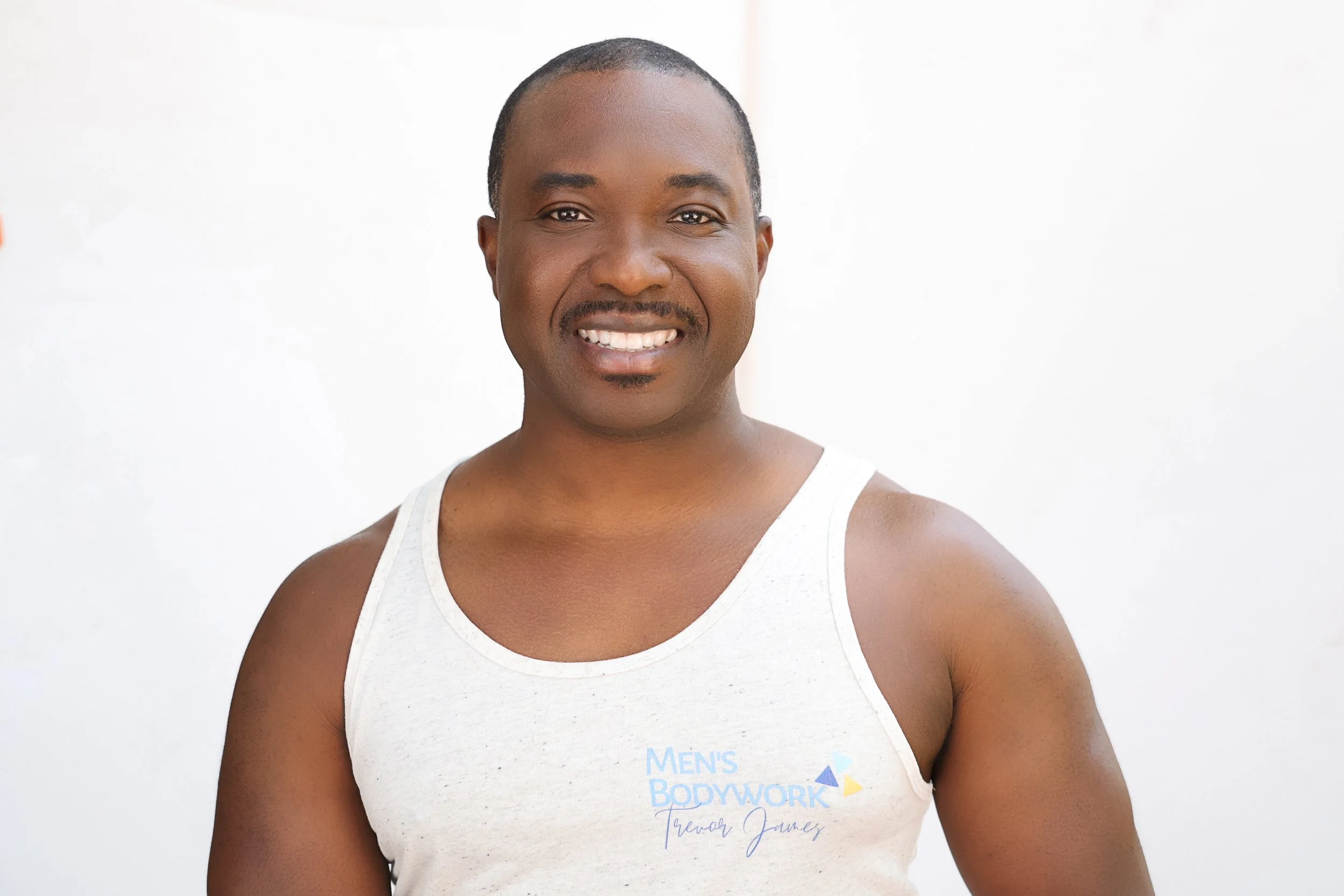
Trevor James is a sacred intimacy practitioner, somatic coach, and author based in Los Angeles. He has worked with gay, bisexual, straight, and curious men for eight years. His studio is in Hollywood. He can be reached at trevor@trevorjamesla.com or at (213) 588-4242.