Sacred Intimacy, Sex Therapy, and Tantric Massage: What's the Difference, and Which One Do You Actually Need?
If you've been researching this corner of the wellness world for any length of time, you've probably noticed that the language gets slippery fast.
Sacred intimacy. Sex therapy. Tantric massage. Somatic coaching. Erotic bodywork. These terms appear in similar searches, sometimes on similar websites, and occasionally as synonyms for each other, which they are not. The overlap in vocabulary is real. The overlap in practice is much smaller than the marketing suggests.
I'm Trevor James, and I've been working as a sacred intimacy practitioner in Los Angeles for eight years. I'm asked this question, in various forms, on almost every clarity call I take: "Is this like therapy? Is this like tantra? How is this different from what I can find on Craigslist?"
These are good questions. They deserve direct answers.
Sex therapy: what it is and who it's for
Sex therapy is a licensed clinical practice. A sex therapist is a mental health professional, typically a licensed marriage and family therapist, licensed clinical social worker, or psychologist, who has received specialized training in human sexuality. In California, they are regulated by the state. They carry malpractice insurance. They maintain clinical records. They operate within a formal scope of practice that has clear legal and ethical boundaries.
Sessions are talk-based. You sit across from a therapist and you talk about your sexual history, your patterns, your fears, your relationship dynamics. A good sex therapist will help you understand the psychological and relational architecture of your erotic life: where certain responses come from, what childhood messages are still running in the background, how attachment styles play out in intimate contexts. The work is real, and for many people it is genuinely useful.
What sex therapy does not do is work with the body directly. There is no touch. There is no somatic experience. The body is referenced in conversation but it is not present as the primary instrument of the work. For some people, that's exactly what they need. For others, it's a significant limitation, because the thing they're trying to change lives below the level of language.
Sex therapy is likely the right fit if: you're navigating a specific clinical issue, you want to work with a partner on relational dynamics, you're processing trauma that requires a licensed mental health framework, or you want to understand the psychological roots of a pattern before you engage with it somatically.
Tantric massage: what it is, what it has become, and why the distinction matters
Tantra is a body of ancient Indian spiritual philosophy and practice. In its traditional forms, it encompasses meditation, ritual, breathwork, and a framework for working with energy, including sexual energy, as a path toward spiritual liberation. It is a serious and sophisticated tradition with thousands of years behind it.
Neo-tantra is the modern Western adaptation. It draws on elements of traditional tantra, sometimes loosely, and applies them to embodiment practices, partner work, and sexuality. When practiced thoughtfully and ethically, neo-tantra offers genuine tools for presence, pleasure, and energetic awareness.
"Tantric massage" in the Los Angeles market is something else entirely, or rather, it is many different things operating under the same name. Some practitioners offering tantric massage are genuinely trained in somatic and energetic bodywork. Others have borrowed the vocabulary because it sounds better than the alternative. The term has no protected meaning, no licensing requirement, and no regulatory oversight. Anyone can use it.
This matters because the gap between legitimate tantric bodywork and a service that uses the language but not the substance is wide, and it is not always visible from a website.
My work is informed by tantric philosophy, particularly its understanding of erotic energy as a life force rather than a problem. But I don't primarily call it tantric massage, because that label has become too diffuse to be useful. What I offer is sacred intimacy: a specific practitioner tradition with its own training lineage, ethical framework, and practice standards.
Tantric massage may be the right fit if: you're drawn specifically to the energetic and spiritual dimensions of tantric practice, and you've done the research to find a practitioner whose training is transparent and whose ethical framework is clear.
Sacred intimacy: where this work actually sits
Sacred intimacy emerged as a named practice in the 1980s and 1990s, developed in part by figures like Joseph Kramer and the Body Electric School, and later articulated by practitioners and writers including Don Shewey. It draws on tantra, Gestalt therapy, somatic bodywork, and a broadly humanistic understanding of sexuality as a dimension of health rather than a source of dysfunction.
The practitioner tradition it comes from treats erotic energy as a resource for self-knowledge, healing, and presence, not as a drive to be managed or a symptom to be treated. Sessions are body-centered, consent-forward, and shaped by what the client brings. There is no fixed protocol. There is a clear container.
What distinguishes sacred intimacy from sex therapy is that the work happens in and through the body, not primarily in conversation. You are not describing your experience to a clinician. You are having an experience, in real time, with a practitioner who is present to your nervous system, your breath, and your physical responses as much as to your words.
What distinguishes it from tantric massage, at least as I practice it, is specificity of intention and depth of container. Every session begins with an explicit negotiation of consent and boundaries. The pace is set by the client. The practitioner's role is not to provide a particular experience but to hold space for whatever experience wants to emerge, with skill and care and no agenda.
What distinguishes it from escort services or any other transactional erotic encounter is that there is no service being purchased in the usual sense. The goal is not a particular outcome. It is presence, attention, and the kind of contact that helps a person feel more at home in themselves.
Sacred intimacy is likely the right fit if: you want to work with your body directly, you're drawn to the intersection of the erotic and the emotional, you're looking for something that isn't clinical but also isn't a transaction, or you've tried talk-based approaches and felt like something important wasn't being reached.
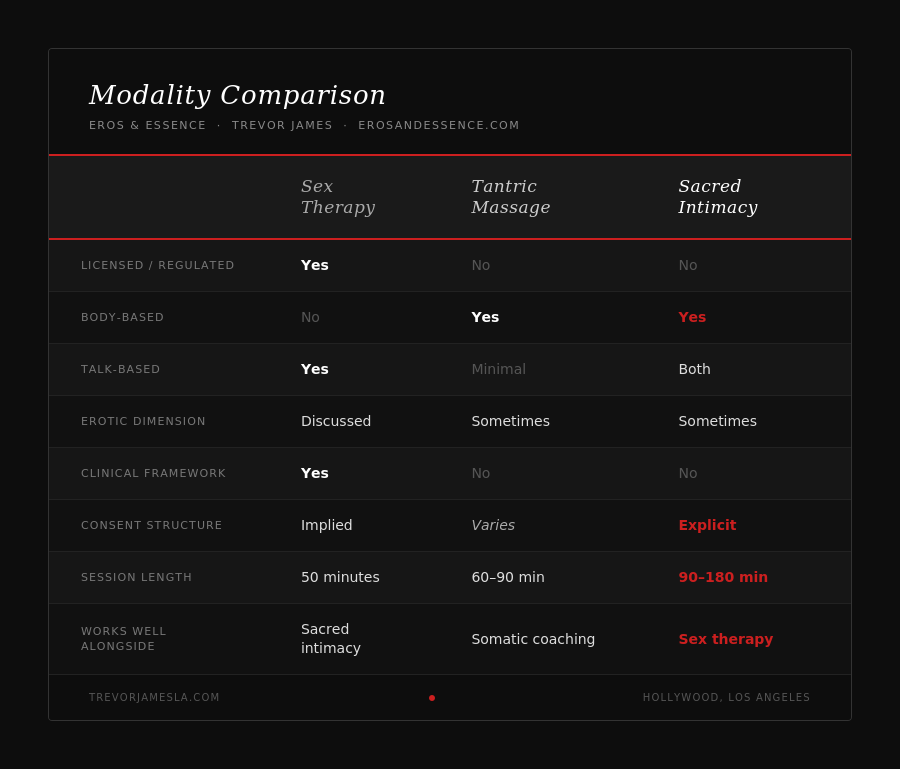
A side-by-side for clarity
You don't have to choose perfectly on the first try
One of the things I notice in men who are looking for this kind of work is a pressure to get the category right before they take any step. As if booking the wrong type of session would be a significant mistake, or as if the categories are more rigid than they actually are.
In practice, many men do more than one kind of work. A client who is in sex therapy and finds the talk-based format useful but incomplete starts coming to sacred intimacy sessions and finds that the two inform each other. Another client who tried what was advertised as tantric massage and felt the container wasn't solid enough arrives here and finds a structure that actually holds.
The question isn't which modality is correct in the abstract. It's which one is responsive to what you're actually carrying right now.
If you're not sure, a 15-minute clarity call is a low-stakes way to talk it through. I'll tell you honestly if I think something else is a better fit.
Frequently asked questions
Can I see a sex therapist and work with a sacred intimacy practitioner at the same time?
Yes, and many clients do. The two modalities work at different levels, talk versus body, and what surfaces in one often deepens the work in the other. If you're in therapy, I'd encourage you to mention this work to your therapist. Most clinicians who are knowledgeable about somatic practices are supportive.
Is sacred intimacy legal in California
Yes. Sacred intimacy is not a licensed profession in California, which means it isn't regulated, but it also means it isn't prohibited. Practitioners operate in a space similar to life coaching or spiritual direction: not a clinical service, not a medical practice, not subject to state licensing in the way a therapist or massage therapist would be. The legality of any session depends entirely on what happens in it. My work is legal because it is not a transactional sexual service. The distinction is real and it matters.
How do I know if a sacred intimacy practitioner is legitimate?
Transparency is the clearest signal. A legitimate practitioner will be clear about their training, their lineage, their ethical framework, and what their sessions do and don't include, before you book anything. They will have a consent process. They will be reachable and communicative. They will not pressure you or use urgency tactics. If a website is vague about what actually happens in a session, that vagueness is usually intentional.
I've had a bad experience with someone who called themselves a tantra practitioner. Should I be worried about sacred intimacy?
Your caution is warranted, and your experience is unfortunately not uncommon. The lack of regulation in this space means that harm happens, and it tends to happen in the gap between what someone advertises and what they actually do. The best protection is the clarity call: talk to the practitioner before you book, ask direct questions, and trust what you notice. If something feels off, it probably is. If it feels solid, that's also information.
Do I need to identify as spiritual to do this work?
No. Sacred intimacy draws on spiritual traditions, but it doesn't require any particular belief system. What it requires is a willingness to be present to your own experience, which is a practice more than a belief.
Trevor James is a sacred intimacy practitioner, somatic coach, and author based in Los Angeles. He has worked with men across orientations and backgrounds for eight years. His practice, Eros & Essence, is located in Hollywood. He can be reached at trevor@trevorjamesla.com or at (213) 588-4242.