Sacred Intimacy in Los Angeles: What It Is, What It Costs, and What to Expect From a Session
Los Angeles is a strange city to feel lonely in.
There are thirty million people within driving distance, ten million ways to stay distracted, and an entire cultural industry devoted to curating the appearance of connection. And yet, so many of the men who find their way to my door have been carrying a particular kind of quiet for years. Not depression, exactly. Not loneliness in the way people usually describe it. More like a distance from themselves. A vague but persistent sense that something in the erotic, emotional, or embodied parts of their lives has gone unreachable.
I work as a sacred intimacy practitioner in Los Angeles, in a private studio near Melrose and Hudson in West Hollywood. I've been doing this work for eight years. The men who book with me are architects, therapists, tech founders, actors, teachers, and retirees. Gay men, bisexual men, straight men, and men who haven't settled on a word for what they are. Most of them have never done anything like this before. Most of them aren't entirely sure how to explain what drew them here.
That uncertainty is the point of this piece. If you've been searching for sacred intimacy in Los Angeles and finding more questions than answers, here is what you actually need to know.
What sacred intimacy is, in plain language
Sacred intimacy is body-centered work. It uses mindful touch, breathwork, somatic awareness, and intentional presence to help people reconnect with parts of themselves they've learned to manage, suppress, or ignore.
The word "sacred" can trip people up. It doesn't mean religious, and it doesn't require any particular spiritual framework. It means that the erotic and emotional dimensions of a person are treated as worthy of care and attention rather than as problems to be solved or appetites to be handled. In that sense, the work is sacred the way a good meal is sacred: it asks you to slow down, to actually inhabit the experience, to be present to what's happening in your body rather than in your head.
The "intimacy" part is also worth sitting with. This is not a transaction. It is not a clinical intake and a set of exercises. It is, genuinely, a form of close attention: one human being holding space for another to feel more at home in themselves.
In practice, sessions combine elements of massage therapy, somatic coaching, breathwork, and erotic energy work, depending on what a client is there to explore. There is no fixed script. There is a clear container: explicit consent, shared agreements, a pace set entirely by the client, and a practitioner who is steady, experienced, and not there to perform anything.
What brings men to this work in Los Angeles
I want to name the real reasons, because the polished language around sacred intimacy can sometimes obscure the very human things that are actually driving people here.
Some men come because sex has started to feel mechanical. They go through it, they complete it, they feel more isolated afterward than before. They don't know how to name what's missing. Some come because they haven't been touched in so long that they've stopped noticing the absence, until one morning they notice it acutely, like a limb they'd forgotten they had.
Some come carrying something from a long time ago. A message they absorbed early in life that their desires were shameful, that their body was something to be managed, that wanting this much was somehow too much. Some come because intimacy with a partner has grown complicated or distant and they want to understand their own part in that before they try to address it with someone else.
And some come because they're queer men navigating an erotic life that has never quite fit the containers that exist for it. Los Angeles has a visible, vibrant queer community, and it also has the same layered complexity of shame, identity, and longing that exists everywhere. Gay and bisexual men often come to this work having never found a space where the full texture of their erotic experience was welcome without agenda or categorization.
In every case, pleasure is not a detour from the work. Often it is the whole point.
What a session with me actually looks like
Before anything happens in the room, we talk.
Every new client begins with a free 15-minute clarity call where you can ask questions, tell me what you're drawn to and what concerns you, and decide whether this feels like a good fit. There's no obligation. No pressure. Just a real conversation.
If you decide to book, the session itself begins with an intake conversation: I'll ask what you're bringing to the work that day, what you'd like more of, what you'd like to stay away from, and what words or phrases I should know about. I'll explain how I work and what the structure of the session looks like. We'll establish your yes, your no, and your maybe. All of this happens with clothes on, at a table or on a couch, with tea if you want it.
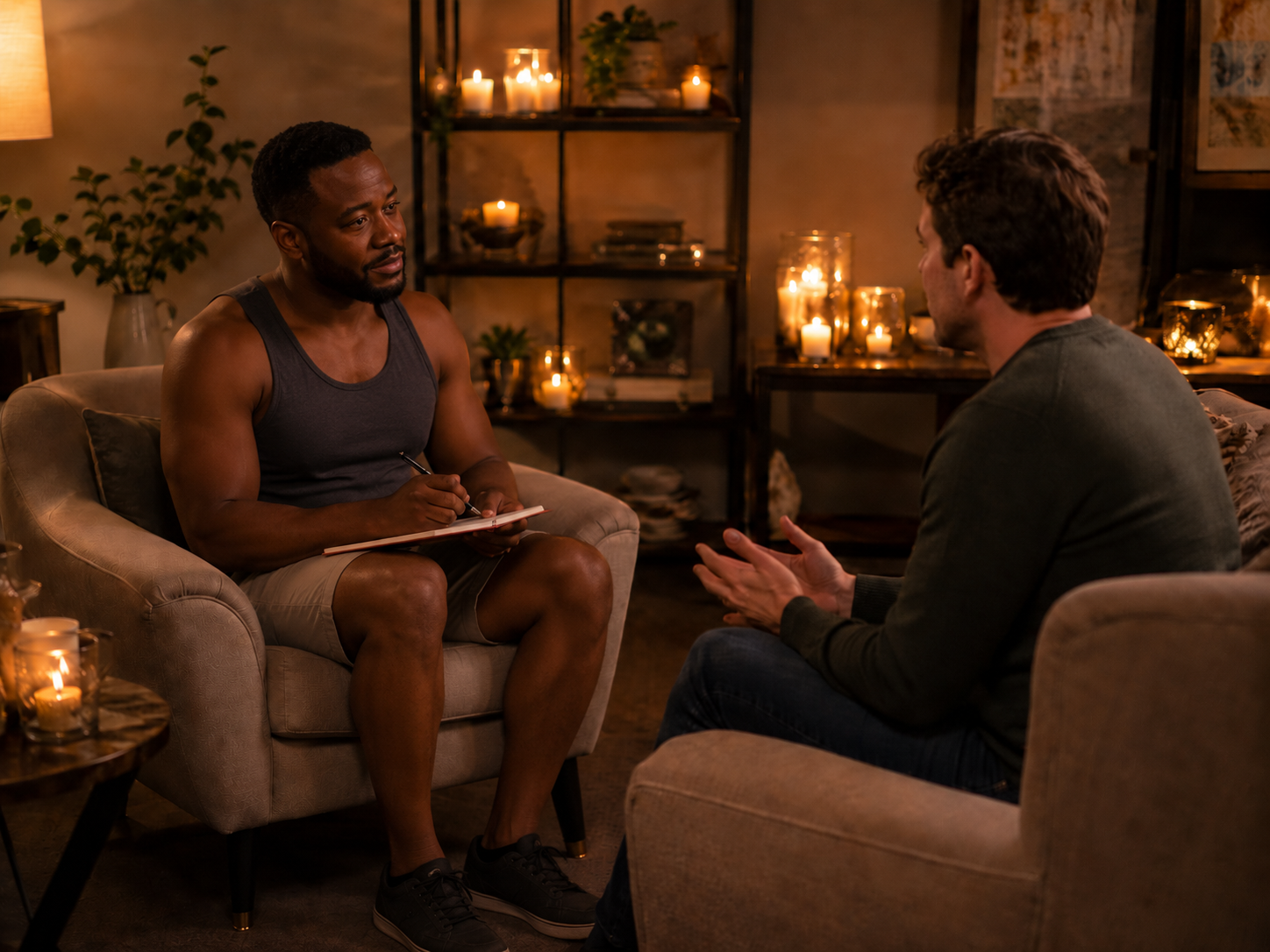
From there, the session is guided and paced by you. Typically it moves through breathwork and somatic settling, touch that begins with the less loaded parts of the body and builds trust gradually, and an exploration of erotic or emotional charge when that's part of why you came. Everything is narrated and checked in on. Nothing is assumed. I am tracking your nervous system as much as your words.
Sessions run between 90 minutes and two hours. Most first-timers book 90 minutes. Many return clients prefer two hours, because some of the most useful work happens in the second half, once the body has had time to actually relax.
The session ends with a grounding sequence, a few minutes of stillness, and time to talk about what came up if you want to. Some men process a lot afterward, sometimes days later. That is completely normal. I'm reachable by message for any follow-up reflection.
What sacred intimacy is not
I want to be direct about this, because the space online for this kind of work is full of ambiguity and misdirection.
This is not a sexual service. It is not a euphemism for something transactional. What happens in a sacred intimacy session is intimate and sometimes erotic, in the same sense that the body is erotic: it is alive, present, and connected to desire and feeling. But it is not performance. It is not exchange. There is no expectation on either side of what the session will produce, and there is no service being purchased in the way that term usually implies.
This is also not therapy, though it works alongside therapy well. I am not a licensed psychotherapist, and I am not there to diagnose, treat, or analyze. I am there to hold a somatic space where experience can move through the body rather than simply be described.
It is not tantric massage, though tantra informs my lineage. Tantric massage has become a catch-all term in Los Angeles that covers everything from legitimate bodywork to something quite different. My work is grounded in consent, somatic awareness, and the practitioner tradition of sacred intimacy, which has its own ethics, training, and practice standards.
Pricing in Los Angeles
At Eros & Essence, sessions are priced as follows:
90-minute session: $250 A good starting point for first-timers. Enough time to settle, establish trust, and do real work.
2-hour session: $350 Recommended for clients who have done one or two sessions already, or who know they need time to arrive before they can relax into anything.
Introductory call: Free. Always.
These prices reflect eight years of professional practice, specialized training across somatic coaching, sacred intimacy, massage therapy, and erotic bodywork, and a private, carefully maintained studio environment in Hollywood.
What to know before you book
A few things I've found useful to say upfront, because they make the first session easier:
You don't need to know what you want. Most people don't, at first. A general sense of what you're drawn toward is enough. "I want to feel more present in my body" is a complete reason to book. "I'm curious but not sure" is also a complete reason.
You don't need to have any particular background. You don't need to have done therapy, or yoga, or anything else. You need to be an adult, you need to be sober for the session, and you need to be willing to communicate.
Nervousness is normal. I'd be more surprised if you weren't a little nervous before your first session. Nervousness is not a sign that this isn't right for you. It usually means the opposite.
And finally: you can change your mind at any point. Before the session, during the session, after we've already begun. The agreement between us is not binding in a way that supersedes your comfort. There is always a door.
Finding me in Los Angeles
My studio is located at Waring Ave at North Hudson Ave in Hollywood, 90038. Sessions are by appointment only, Monday through Sunday, 10am to 11pm.
I primarily serve clients in Los Angeles, including West Hollywood, Beverly Hills, Westwood, Silver Lake, Los Feliz, Echo Park, Silverlake, Koreatown, Mid-City, Brentwood, Santa Monica, and the greater LA area. I also work with clients who travel to Los Angeles and want to schedule a session during their visit.
If you've been reading this and something in you recognized itself, the best next step is a 15-minute clarity call. It's free. It's low-stakes. And it will tell you far more than this page can.
Frequently asked questions
I've never done anything like this. How do I know if I'm ready?
You probably don't, and that's fine. Readiness, in this context, doesn't mean you've worked through all your complicated feelings about touch or desire or vulnerability before you arrive. It means you're curious enough to show up and willing enough to communicate. That's the entire threshold. Everything else gets figured out together, in the room, at whatever pace your body sets.
I'm nervous about getting aroused. Is that a problem?
No. Arousal is a natural physiological response to touch, and this work doesn't treat it as something to be managed or apologized for. It also doesn't treat it as the goal. The nervous system does what it does. What matters is that you're present to your experience, not performing a particular one. I've worked with men across the full spectrum of physical response, and none of it is surprising or uncomfortable to me.
What if I get emotional, or cry?
That happens more often than you might expect. Sometimes it happens to men who were quite sure it wouldn't. The body holds things, and when it finally gets a moment of genuine care and unhurried attention, some of what it's been holding moves. Emotion in a session isn't a problem or a detour. It usually means the work is working.
How is this different from seeing a sex therapist?
Sex therapy is talk-based. A sex therapist is a licensed clinician who works with you to understand patterns, histories, and dynamics, primarily through conversation. Sacred intimacy works through the body directly. There's no diagnosing, no treatment plan, no weekly verbal processing session. The two modalities complement each other well. Some of my clients are in therapy at the same time, and they find that what moves in a somatic session gives them useful material to bring to their therapist. But they're doing different things.
How is this different from a tantric massage I can find on Craigslist?
Meaningfully different, and I think it matters to say so plainly. "Tantric massage" has become one of the most misused phrases in Los Angeles, covering everything from genuine somatic bodywork rooted in tantric philosophy to services that have nothing to do with tantra and everything to do with something else entirely. My work is grounded in a specific practitioner lineage, trained practice, and a clear ethical framework. Every session begins with an explicit consent conversation. Nothing happens without your awareness and agreement. The container is real, not decorative.
I'm a gay man. Is this space actually for me, or am I going to feel like an afterthought?
You're not an afterthought. A significant portion of the men I work with are gay or bisexual, and the work is shaped by that reality, not retrofitted for it. Gay men carry particular histories around the body, desire, shame, and what it means to be seen, and I work with those specific textures rather than around them. Los Angeles has no shortage of wellness spaces that claim inclusivity as a brand position. I'd rather you judge this one by what actually happens in the room.
I'm bisexual, and I've never really talked about that with anyone. Is that something that can come up here?
Yes, and it often does. Bisexual men frequently navigate a kind of double invisibility: not queer enough in some spaces, not straight enough in others, and rarely given a context where the complexity of their erotic experience is simply accepted as complete. Sessions here don't require you to have resolved your identity before you arrive. You can bring all of it.
Do I need to be in a particular physical condition? I'm self-conscious about my body.
No particular physical condition is required or preferred. The men who come through my door are in their twenties and their seventies, in various states of fitness, with various relationships to their physical appearance. Self-consciousness about the body is one of the things this work tends to address, not something you need to overcome before you can access it. You are welcome here as you are.
What if I decide partway through that I want to stop?
Then we stop. This is not a contract you're bound to honor. If something doesn't feel right, if you want to slow down, change direction, or end the session entirely, you say so and that's what happens. No explanation required. The consent framework we establish at the beginning isn't a formality. It's the actual structure of the work.
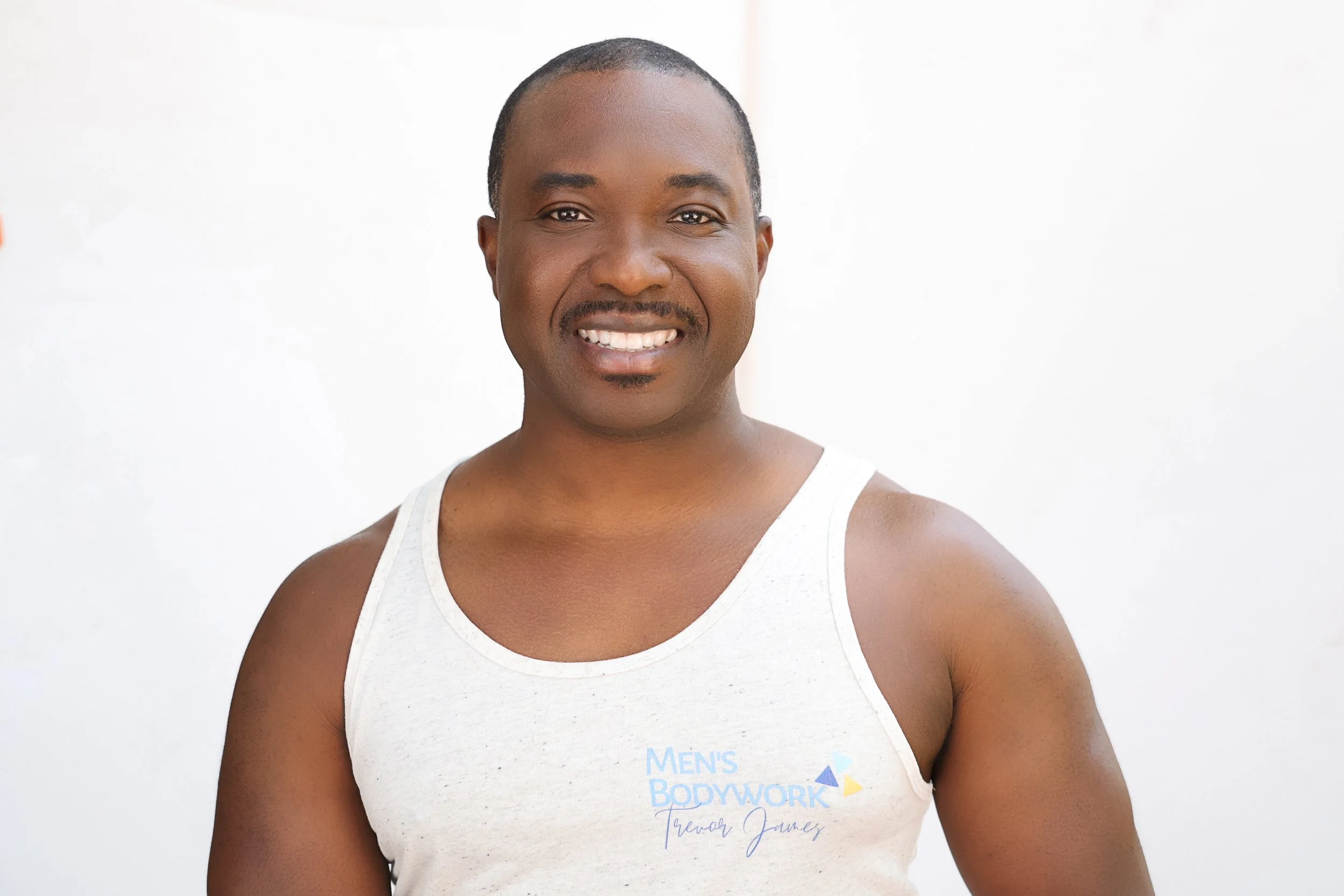
Trevor James is a sacred intimacy practitioner, somatic coach, and author based in Los Angeles. He has worked with men across orientations and backgrounds for many years. His practice includes sacred intimacy sessions, massage therapy, cuddle therapy, and 1:1 intimacy coaching. He can be reached at trevor@trevorjamesla.com or at (213) 588-4242.