Men’s Sacred Intimacy in Los Angeles: What It Is, Who It's For, and What to Expect
Let's start with the thing everyone wants to ask but usually doesn't.
No. Sacred intimacy is not a euphemism. It is not a workaround, a loophole, or a particularly creative way to describe something illegal. I know that the internet has made this confusing, and I know that certain corners of certain websites have not helped.
The Short Answer
Sacred intimacy can include touch that is sensual, and in some modalities, erotic. It is not a sexual service. Those are different things, and the difference matters.
What separates sacred intimacy from a sexual encounter isn't a list of rules or a disclaimer at the bottom of a page. It's intention, container, and presence. The work is rooted in your healing, your wholeness, your relationship with your own body. That's a different center of gravity than sexual gratification, even when the body is involved.Sacred intimacy is a healing practice that works at the intersection of body, energy, and emotional awareness. It draws from Tantric traditions, somatic therapy, and conscious touch. It is professional, boundaried, and held within a clear ethical container. And for the right person at the right moment, it can be one of the most significant experiences of their life.
Why the Question Is So Reasonable
If you're asking this, you're not being inappropriate. You're being honest. And in my experience, the men who ask this question directly are usually the ones who are ready for something real.
The confusion is understandable. "Sacred intimacy" is a phrase that sounds deliberately mysterious. It sits in a cultural gray zone, somewhere between therapy and spirituality and something most people don't have a clean category for. Add the word "erotic" to the conversation, and the question becomes even more reasonable.
We've been taught, most of us, that sensuality and spirituality are opposites. That the body is something to manage or overcome, not honor. Sacred intimacy starts from the opposite premise: that your body is intelligent, your desire is information, and your capacity for pleasure is connected to your capacity for presence, for connection, for being fully alive.
That's a different framework. It takes a little time to feel into.
Where It Comes From
The word "sacred" is doing real work here. It points to a tradition of recognizing the body not as something to be managed or performed but as a site of genuine wisdom and healing potential.
Tantric philosophy, from which much of this work draws, is not primarily about sex. It is about energy: how it moves, where it gets stuck, and what becomes possible when it flows freely. Sacred intimacy practitioners work with that energy through breathwork, intentional touch, somatic awareness, and presence.
The "intimacy" part refers to closeness in its deepest sense. Not romantic, not sexual, but real: two people in a room, one of them held with full attention and care, no performance required.
Who It's For
Honestly? More men than you'd expect.
Men who have a complicated relationship with their bodies and are ready to do something about it. Men who feel disconnected from themselves, not just from others. Men who have been through something, and find that talking about it only gets them so far.
Men who are gay, bisexual, or queer and have spent years navigating touch that came loaded with expectation. Men who are straight and simply never had a space to explore their relationship with their own bodies outside of performance or function.
Men who are curious about Tantra but have no idea where to start and are reasonably skeptical of anything that sounds like a weekend retreat in the hills with a lot of scarves.
Men who are doing well, actually, and just sense that there's more available to them than they've yet accessed.
You don't need a diagnosis. You don't need a crisis. You need a genuine desire to show up honestly for yourself, and a willingness to be in your body rather than just thinking about it.
What Actually Happens in a Session
A sacred intimacy session begins before anyone touches anyone.
We talk. I want to know what's present for you today, what you're hoping for, what your body is holding. This is not small talk. It's part of the work, because arriving consciously matters.
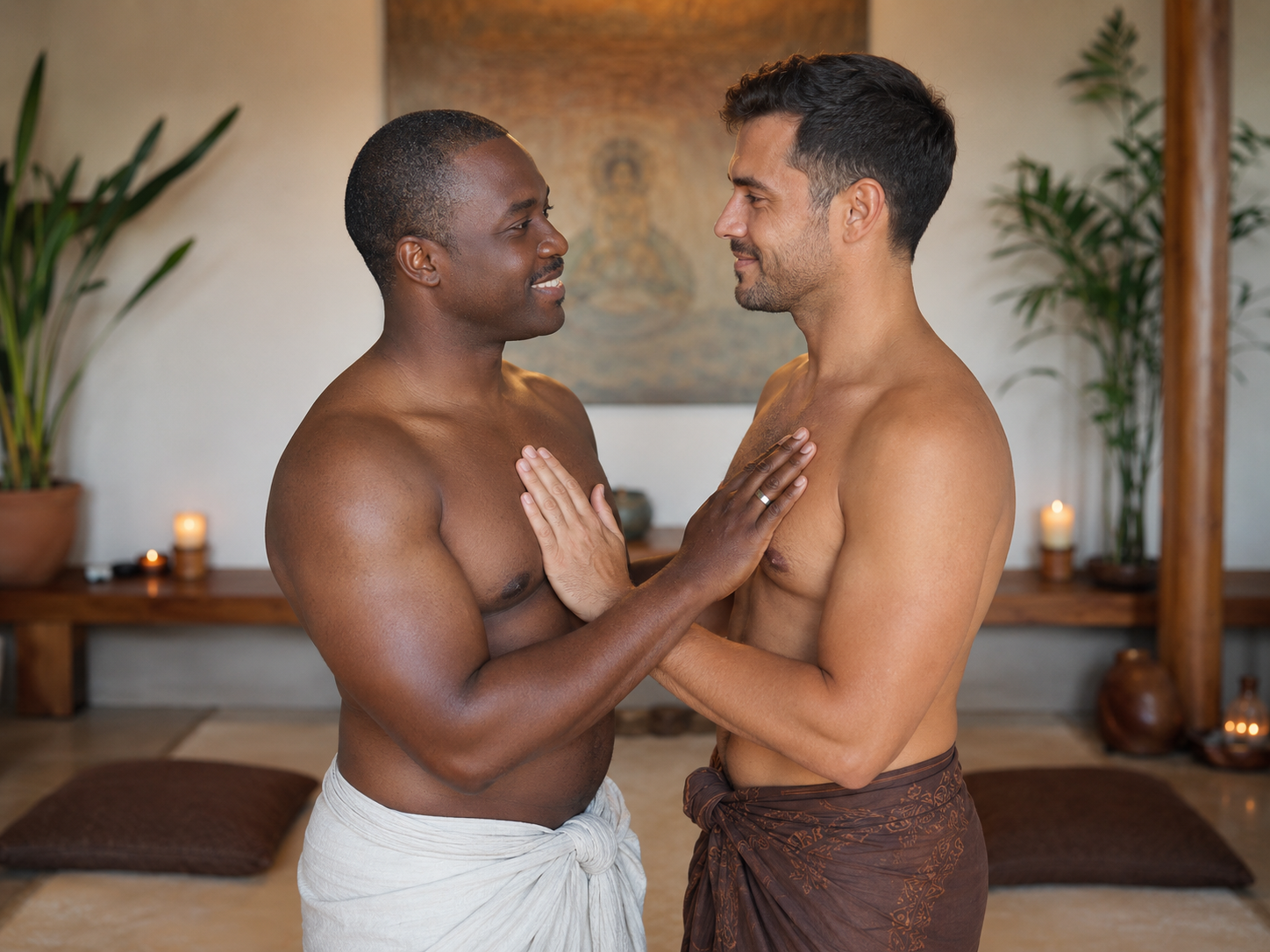
From there, we move into the session itself. Depending on what you need, this might include guided breathwork, which is more powerful than it sounds and I say that as someone who was skeptical about it for years. It might include energy work, somatic awareness practices, or therapeutic touch that is intentional, present, and specific to what your body and nervous system need in that moment.
Throughout, you remain in charge. Consent is ongoing. If something doesn't feel right, or if you need to slow down, or if you want to stop entirely, those are all legitimate and respected options. The session is yours.
Every session is different, because every person is different. What I offer is a thoughtful, consent-forward space where we might work with breathwork, somatic touch, guided awareness, or conscious physical presence, depending on what's alive for you and what you're there to explore.
There is no script. There is no performance. There is no pressure to experience anything in particular.
We close with integration time. This matters more than most people realize. What happens in a sacred intimacy session can move things that have been stationary for a long time. Giving yourself space to land before walking back into the world is not optional. It is part of what makes the work last.
Where the Line Is
Sacred intimacy, in its traditional and contemporary practice, acknowledges the full body, including parts of the body that are usually excluded from therapeutic or healing contexts. That acknowledgment, approached with care and clear intention, can be profoundly healing for some people.
What it is not: a transaction. It is not a performance for your benefit or mine. It is not a service designed to produce an outcome. The moment the work becomes about a destination, it stops being sacred intimacy and becomes something else entirely.
The container I hold is intentional, boundaried, and consent-driven at every step. If something isn't right for you, you say so. If something isn't right for me, I say so. That mutuality is part of what makes the work what it is.
Why Los Angeles, and Why Now
LA has a long, genuine relationship with this work. The city's mix of spiritual curiosity, body awareness culture, and relative social openness makes it more receptive to sacred intimacy than most places. There are skilled practitioners here. There are also, as in any city, practitioners who use the language without the training or the ethics. Knowing the difference matters.
Look for someone with documented training in somatic work, Tantra, or sacred sexuality modalities. Look for clear professional language about what sessions include and what they don't. Look for an intake process that takes you seriously before you've paid anything.
And trust your instincts. If something in the language or the energy of a practitioner's presence feels off, it probably is.
One Last Thing
Men come to this work carrying a lot of names for what they need. Relief. Connection. Healing. A reset. An answer to something they can't quite formulate as a question.
All of those are welcome here. You don't need to arrive with the right vocabulary. You just need to arrive.
If you're curious and want to talk it through before committing to anything, that's exactly what the free Clarity Call is for.
If You're Still Not Sure
That's fine. You don't have to be sure before you reach out.
A first session, or even a conversation before that, is just an opportunity to ask your questions, feel into the space, and decide from there. There's no obligation. There's no pressure. I'd rather you take the time to feel genuinely ready than push past your own hesitation to get somewhere faster.
The men who get the most from this work are the ones who arrive with honesty: honest about what they're curious about, honest about what they're afraid of, honest about what they're hoping for.
That kind of honesty is a good place to start.
Ready to explore? You can book a session directly at the link below, or reach out with questions first. Either way, the conversation is welcome.